

THE LATEST
Doubles Final in Austria
Turning 22
Why I Turned Down Being a US Open Alternate
3k Followers on Instagram
JOURNEY UPDATE
Doubles Final in Austria
August began with the only high-level competition on my calendar this month, in Groß-Siegharts, Austria.
The tournament was played on astro — a surface not used on the ATP, WTA or Challenger tours, but one that tends to suit my game well. In terms of how the ball plays and how the court feels, it’s somewhat similar to grass.
In singles, I came through my opening match convincingly before frustratingly falling to an early exit against the world number 25, losing 4–6, 0–6.
The frustrating part was that I had been comfortably in control, leading 4–1, with three consecutive break points. Then, quite suddenly, it felt like my wheels just fell off. My energy levels dropped, I started struggling with my decision making, and I couldn’t find a way to turn things back around.
Ultimately, that’s tennis. It doesn’t matter what the score says if you stop performing at the level required to win the match — eventually, you’re going to lose.
It would have been easy to write the result off as a bad day and move on. But doing that would have meant missing one of the most valuable parts of competing: understanding what went wrong and working on it, so that you are better prepared for when you next find yourself in a similar situation.
It’s far too easy to take the positives from a win and dismiss a loss as simply “one of those days”. In reality, every match deserves some reflection afterwards — there’s always something to take from both a win and a loss.

Photo by Austrian Open 2026
In doubles, alongside Ben Bartram (GBR), we made the final after coming through matches against home favourite Nico Langman (AUT) and Geoffrey Jasiak (FRA), 6–1, 6–1, before beating Nico Charrier (FRA) and Maximillian Taucher (AUT), 3–6, 7–5, 10–6 in the semi-finals.
We ended up losing the final to last year’s winners Frederic Cattaneo (FRA) and Alwande Sikhosana (RSA), 3–6, 4–6.
It was our third tour-level final as a pair, but our wait for a first title together goes on. It was a match of fine margins, with more than 12 games going to deuce, but unfortunately, we couldn’t find a way to convert enough of our opportunities.
On Court
Most of this month has been spent in a three-week training block following Austria, ahead of the events in the USA and Canada.
After two months of playing on a mixture of grass, clay and astro, it’s always nice to get back onto my favourite surface. The consistency of the bounce on hard courts makes it much easier to find a rhythm during training.
The main focus of this training block has been continuing to work on flattening out my ball shape when moving inside the court.
As I push to secure my place in the Grand Slams, becoming more comfortable taking time away from the better players is going to be important. I need to be able to create pressure rather than simply allowing my opponent to dictate the point.
That has meant a lot of work on short-ball finishing, flattening out while trading and creating opportunities to move forwards and finish points.
Being aggressive doesn’t necessarily come naturally to me. I don’t particularly like taking unnecessary risks, but part of the process has been recognising that these aren’t risks at all — they’re calculated decisions where the odds are more in my favour than if I were to play more cautiously.
Tennis can be won or lost on either racket, but if you want to reach the top, you need to make sure the majority of points are being won on your own.
August in Numbers
1 competition
5 matches
65.5 hours on court
15 gym sessions
11 rackets strung
5,207 miles flown
#21 singles ranking
#20 doubles ranking
BEHIND THE SCENES
What You Didn’t See
One of the realities of any training block is that not every day is going to feel good.
Some days everything clicks and you leave the court feeling like you couldn’t have hit the ball any better. Then, sometimes without any obvious reason, the next session can feel completely different.
The closer you get to your next set of tournaments, the more pressure you naturally put on yourself. That was certainly the case for me this month.
On the second-to-last day before heading to America, everything felt off. I was doubting my technique, I didn’t feel like I was reading the ball properly, and I wasn’t making the decisions like I normally would.
It was deeply frustrating.
When that happens, it’s amazing how quickly your mind can start spiralling. Am I actually ready to compete in less than a week? What if I’m not ready? I don’t even want to be here.
But these are the sessions where pushing through can mean more than any great training session.
You’re not being tested on how well you can play when everything feels perfect. You’re being tested on how you respond when it doesn’t.
For me, that meant accepting it was simply a bad day and continuing to give it my best, while also accepting that I might not be able to execute shots to the level I normally would.
Lowering the pressure and expectations helped change the way I viewed the session. Instead of worrying about how well I was playing, the goal became much simpler: get through it, do what I could, and move on.
Those days can happen in the middle of a tournament too. Sometimes you won’t feel great, you won’t play your best tennis, and it won’t look pretty.
But if you can still find a way to get the result, you give yourself another opportunity the next day to find your best level.
Why I Turned Down Being an US Open Alternate
At tournaments without qualifying, it’s common — particularly at Grand Slam level — for tournaments to want players on site in case of a last minute withdrawal, helping ensure that draws don’t end up with any vacancies.
At the US Open, each wheelchair division has two on-site alternates, which all but guarantees that the draws remain full, in case of any withdrawals.

©US Open 2022
Despite withdrawals being somewhat common in the able-bodied game, it’s extremely uncommon for a wheelchair player to withdraw from a Grand Slam without playing. This is because the Grand Slams are the only wheelchair tournaments with significant prize money. Even travelling and losing in the first round makes great financial sense for someone managing an ongoing injury.
I was offered the chance to travel to New York as the second alternate. There was some contribution towards accommodation and a small travel grant, but ultimately, the cost of travelling to and staying in New York didn’t outweigh the opportunity to compete in a 100 event in Toronto at the same time.
I couldn’t tell you the last time two alternates got into a Grand Slam at the last minute, so while the potential financial reward of making the draw is significant, it simply didn’t make sense for me.
Instead, I have the opportunity to compete for a singles title in Toronto, in a draw without any of the top 14 players.
Turning 22
Yep, I turned 22 in August.
There’s nothing particularly significant about turning 22, but it’s still a nice opportunity to reflect on how much has changed over the last few years. My operation was almost eight years ago now, and I certainly wouldn’t have predicted where I’d be today.
Here’s to whatever the next 12 months bring.
3k Followers on Instagram
Another big month on the platform, gaining more than 20% of my follower count in less than a week — including more than 400 followers from a single reel.
I’m starting to take posting a little more seriously, as I’m increasingly seeing the long-term value in building a platform alongside my tennis — both for the platform itself and for the potential sponsorship and media opportunities that can come with it.
There’s still a massive lack of media attention within not just wheelchair tennis, but disability sport more broadly.
I firmly believe it’s our responsibility as players to help promote the sport, share our stories and show the potential that wheelchair tennis has moving forwards.
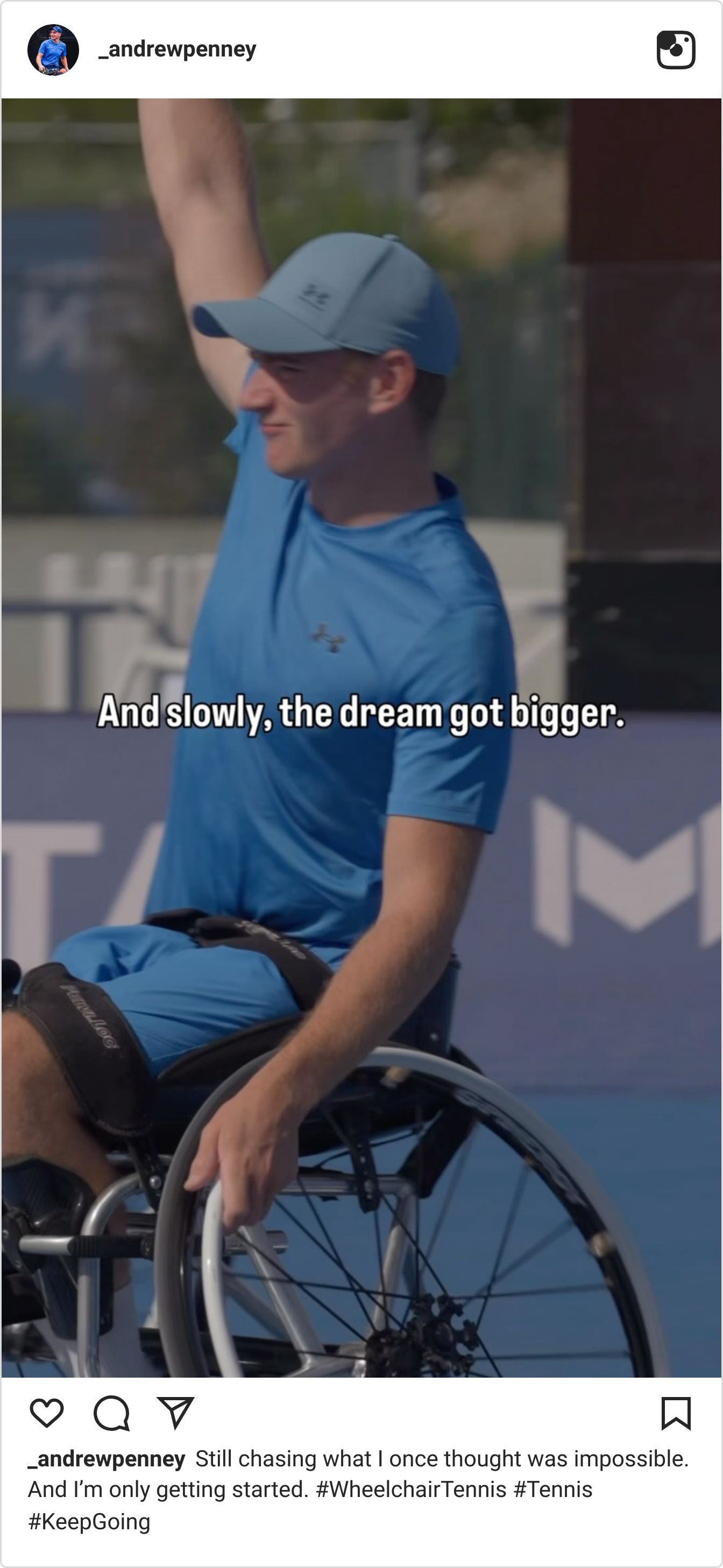
My current goal is to reach 5k followers on Instagram before 2027.
That means averaging more than 15 new followers a day, which sounds like a lot when you have days where you don’t gain any — or even lose a few.
Then again, I’ve also had single days where I’ve gained more than 400.
So we’ll see. Only time will tell whether or not we get there before then.
The Unseen Work
From the outside, playing professional tennis can look like a pretty glamorous life — travelling around the world and visiting places most people would only dream of seeing.
And there are certainly plenty of great moments.
But there’s also far more to it than meets the eye.
At competitions, while there can be plenty of free time around matches, much of that time is spent preparing.
Building routines, doing match preparation, mental and physical preparation, and making sure you’re eating properly — and safely — even when you’re in countries where the food is very different to what you’re used to.
The last thing you want the day before a match is to become unwell from something that simply doesn’t agree with you.
Training weeks offer more freedom, but that freedom comes with responsibility. Nobody is stopping you from training just a few hours each week. Ultimately, though, you’re responsible for your own success, and maintaining the right standards and training volume is part of that.
In my case, four hours on court most days, plus more than an hour in the gym and warm-ups for every session already takes up a significant chunk of the day.
Then there’s everything around the tennis: organising training, sorting tournament logistics, booking flights and hotels, finding doubles partners, among a lot more.
Then there’s also sponsorship outreach.
Finding sponsorship is far harder than you might think. Everyone is looking for similar things, and unless you have a way to stand out, it’s very easy to get overlooked.
And then there’s social media.
This month, I experimented with a new type of reel: “How does the wheelchair tennis tour actually work?”
The idea was to explain (with visuals) how the wheelchair tennis tour structure and ranking system works. From start to finish, that one reel took more than 10 hours of work.
It was then massively outperformed by another reel that took less than an hour to make.
That’s the reality of social media. You can spend hours creating something you think people will love, only to watch something you threw together quickly perform far better.
People’s attention spans have changed significantly, and unless you can give someone a reason to stop scrolling, it doesn’t matter how good the rest of the reel is.
I feel like I’m starting to understand the algorithm, but every time I think I’ve figured it out, I’ll post something I expect to perform well… and it underperforms.
Changing Surfaces
People often ask what the difference is when changing surfaces in a wheelchair.
For an able-bodied player, it might mean changing to a different pair of shoes with more or less grip. For wheelchair players, it’s not too dissimilar — except instead of changing shoes, we change tyres.

Most players use three main types: Tufo, Kenda and IRC.
Tufo and Kenda tyres are typically better suited to hard courts, with a narrower profile that provides more grip and allow quicker turning on the grippier acrylic courts.
Tufo tyres, despite offering lower rolling-resistance, are more expensive, and can wear incredibly quickly — sometimes needing to be changed every week or two.
For training and matches on other surfaces, most players opt for IRC tyres. These have a wider profile, helping players glide over the surface more easily.
On clay, a narrower profiled tyre can cause you to sink into the surface, slowing your movement. On grass, astro and carpet, the wider profile similarly helps reduce surface resistance, allowing players to move more easily.
Each tyre has it’s own slightly different height, which means different castor sizes are used to maintain the same chair setup angle.
Training at Wimbledon

©AELTC/Andrew Baker
For the first time since that special week, I was back at the All England Lawn Tennis Club.
Two ATP Challenger events were taking place at the National Tennis Centre, which meant the outdoor courts we normally use weren’t available. We were therefore offered the opportunity to train at Wimbledon instead, using their outdoor hard courts.
Who knew Wimbledon even had those? I certainly didn’t until just the other week!
Off Court
As I mentioned earlier, it’s been a busy month of training, admin and working on improving my socials, but finding time to switch off away from the court is just as important.
For me, that usually means binge-watching videos on YouTube.
YouTube is where I relearnt almost everything following my complete memory loss, and I’m still constantly learning new things!
People often ask what my favourite type of video to watch is, and my answer is the show Jet Lag: The Game.
The latest season started a couple of weeks ago, this time with a race across Japan.
I love these kinds of concepts because they combine two things I enjoy: travelling and exploring new places, along with strategy and competition.
LOOKING AHEAD
Upcoming Events

Toronto 2025 Doubles title w/ Connor Stroud (USA)
This week I’ve been competing in Maryland, USA, and next week I’ll be in Toronto, Canada.
After that, I have a week back training at home during the World Team Cup, which I’m not playing in this year, before heading to La Courde Sur Mer in France for a 175 event.
I’ll then finish the month at the French Riviera Open 1000 in Nice, France.
It’s going to be a busy month of competitions and travel, but hopefully that will offer plenty of opportunities to pick up some big wins and continue improving my ranking as we head towards the end of the year.
The Next Step

Photo by Austrian Open 2026
The Focus: Turning my level on the training court into matches.
I’ve been playing some really good tennis in training, but the challenge now is taking that level into competition and producing it when it matters.
It’s about making the things I’m doing well in training become more consistent when the pressure of a match arrives.
The Goal: Win a singles title before the end of the year.
It’s a simple one, but there’s still time left on the calendar and plenty of opportunities to chase it.
The focus now is on putting the work in, giving myself the best possible chance at each tournament, and hopefully ending the year with a first singles trophy since College Park two years ago.
The Takeaway: Every loss has something to teach you.
Every match gives you an opportunity to learn, improve and come back stronger — but only if you take the time to understand what went wrong, what you could have done differently, and what you can take forward.
Losing is part of the journey. Making the effort to learn from it is what matters.
Some things go to plan. Some don’t.
Either way, there’s always something to take from it.
On to the next one.
Andrew